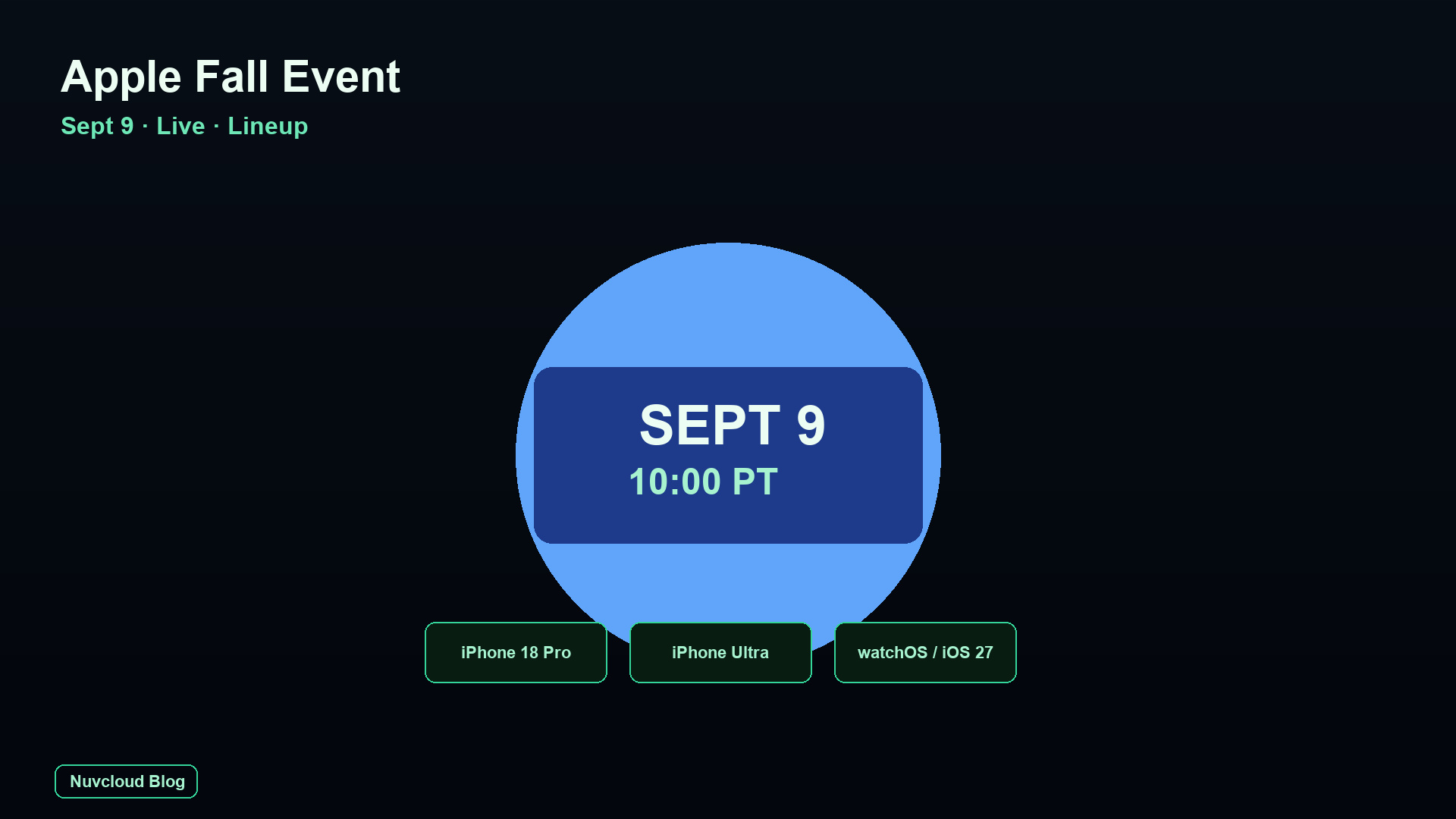
Apple has officially locked it in: the 2026 fall event is Wednesday, September 9 at 10:00 a.m. Pacific Time at Apple Park in Cupertino, under the theme Surprise and Shine. For viewers in Mainland China, Hong Kong, and Taiwan, that is 1:00 a.m. on Thursday, September 10. The stream will run on Apple's website, YouTube, and the Apple TV App—John Ternus's first major product show since becoming CEO on September 1.
Bottom line: This is a classic iPhone night, not a Mac keynote. The high-probability lineup is iPhone 18 Pro / Pro Max and the rumored first foldable iPhone Ultra; the standard iPhone 18 is expected to wait until spring 2027. The M6 iMac and M6 MacBook Pro look more like an October window. iOS developers should focus on the iOS 27 SDK and Xcode adaptation window, not a desktop Mac that has not been announced.
As of August 28, 2026, Apple has confirmed the date and theme through the official invitation and executive social posts. MacRumors and AppleInsider both report the event will be held at Apple Park, starting at 10:00 a.m. Pacific, with on-site media hands-on. USA Today independently confirmed 1:00 p.m. Eastern. The invitation does not name a single product; everything below except the date, time, and streaming channels is supply-chain and press reporting, not official specs. (Apple Events · USA Today)
If you are mapping the full 2026 cadence, start with our 2026 Apple leak roundup, M6 iMac release timing and specs, and new iPhone leaks and iOS development strategy.
When it starts: September 9 time-zone cheat sheet
The official start is Wednesday, September 9, 2026, at 10:00 a.m. Pacific Time (still daylight time that day: PDT, UTC−7). Converted to major time zones:
| Region | Local time | Date |
|---|---|---|
| U.S. West Coast (PDT) | 10:00 | Wednesday, September 9 |
| U.S. East Coast (EDT) | 13:00 | Wednesday, September 9 |
| United Kingdom (BST) | 18:00 | Wednesday, September 9 |
| Central Europe (CEST, DE/FR) | 19:00 | Wednesday, September 9 |
| Moscow (MSK) | 20:00 | Wednesday, September 9 |
| India (IST) | 22:30 | Wednesday, September 9 |
| Mainland China / Hong Kong / Taiwan | 01:00 | Thursday, September 10 |
| Japan / South Korea | 02:00 | Thursday, September 10 |
| Eastern Australia (AEST) | 03:00 | Thursday, September 10 |
Open the stream 5–10 minutes early. Recent Apple events are still mostly pre-recorded, with media hands-on on campus as the live layer. Once the intro music hits, product segments move fast—late arrivals miss the first hardware reveal.
How to watch: website, YouTube, Apple TV
Apple has already posted a placeholder video on YouTube and a countdown on the events page. Three official doors cover almost every device:
- Apple Events page: apple.com/apple-events—any desktop browser, no login required;
- YouTube: the official Apple Events channel; hit “Notify me” for a start ping. Most reliable on Windows and Android;
- Apple TV App: iPhone, iPad, Mac, Apple TV, and compatible smart TVs. No Apple TV+ subscription required.
After the show, the same links usually keep a full replay—useful for checking prices, pre-order times, and the press release against what you thought you heard. If YouTube is unreliable on your network, use the website or read a text recap later.
MacRumors also runs a live blog (site plus the MacRumorsLive account). If you only care about “when do pre-orders open, what does it cost, what is the trade-in,” text is faster than video.
Product list: confirmed vs. high-probability rumors
The invitation confirms time, place, and theme—nothing else. The table below separates what Apple has already nailed down from what the press has converged on, so rumors do not get treated as a spec sheet.
| Item | Status | Notes |
|---|---|---|
| Date / time / stream | Official | September 9, 10:00 PT; website, YouTube, Apple TV App |
| Theme Surprise and Shine | Official | Some regional sites use a localized slogan with the same meaning |
| John Ternus debut | Leadership confirmed | Became CEO on September 1; this is his first fall show |
| iPhone 18 Pro / Pro Max | High probability | Fall events are historically the Pro stage |
| Foldable iPhone (Ultra / Fold) | High probability | First new form factor since iPhone X in 2017 |
| Apple Watch Series 12 / Ultra 4 | High probability | Almost always shares the iPhone night |
| Home Hub / new Apple TV / HomePod mini | Possible | Home line is reportedly ready, but not guaranteed for September |
| iPad mini 8 (OLED) | Possible | Code leaks point to OLED; could slip to a second event |
| Standard iPhone 18 / iPhone 18e / Air 2 | Low probability (this event) | Multiple reports move cheaper models to spring 2027 |
| M6 iMac / M6 MacBook Pro | Low probability (this event) | Fits the October Mac window better |
iPhone 18 Pro / Pro Max: 2nm A20 Pro and pricing pressure
The 2026 iPhone lineup is being split in two: Pro first in the fall, with the standard and cheaper models held for next spring. That is not “canceling iPhone 18”—it is clearing the September stage for the high end and the foldable.
Where reporting is relatively aligned:
- Chip: all three new phones (including the foldable) point to TSMC 2nm A20 Pro; packaging improvements should keep sustained loads cooler;
- Modem: Apple's in-house C2 modem is expected to stay standard;
- Design: overall silhouette continues from iPhone 17 Pro; the camera island may grow slightly, and a deep cherry color has been rumored;
- Camera: a variable rear aperture is more likely on Pro Max first; under-display Face ID is still a “maybe,” not a lock;
- Price: the memory-price cycle has not fully eased; some reports put Pro around $300 above the previous generation—treat launch-day pricing as the only number that counts.
If you already have an iPhone 16 Pro or 17 Pro with enough storage, this looks like a chip and camera tweak, not a new shape. For developers, the real watch items are the A20 Pro + iOS 27 minimum baseline and the new window sizes a foldable brings.
Foldable iPhone Ultra: first-gen form and trade-offs
This is the product easiest to write as a “revolution”—and the one that most needs a sober look at trade-offs. MacRumors says it may be called iPhone Ultra; other reports still use iPhone Fold. Whatever the final name, the form-factor description is consistent:
- Book-style fold: about 5.3–5.5 inches closed on the cover display, about 7.6–7.8 inches open—closer to a small tablet than a long, skinny phone;
- Dual-display cameras: punch-hole on the cover, possible under-display camera inside; rear cameras rumored as dual 48MP with no telephoto;
- Unlock: the chassis is extremely thin, so rumors favor Touch ID instead of Face ID;
- Specs: A20 Pro and about 12GB of memory, positioned as a flagship rather than a science project;
- Price: pre-launch ranges cluster at $2,000–$2,500, sometimes higher; the U.S. may go first, other markets later;
- Availability: a September announcement is not a September street date. First-gen foldables that you can pre-order and then wait for are common.
For regular upgraders, the question is whether you want a first-generation curiosity. For iOS teams, it is getting dual-window and unfolded layouts working in Xcode. Even if you never buy one, apps will be opened on it quickly.
Apple Watch, home devices, and iPad mini
Beyond phones, a fall event usually squeezes in watches and one or two “Apple for the house” products. Expectations for 2026 are modest, not empty:
- Apple Watch Series 12: a radical redesign is unlikely; new health sensors and a band-attachment change are the main rumors;
- Apple Watch Ultra 4: possible look or sensor tweaks; details are still thin;
- HomePod mini / Apple TV 4K: more of a silicon bump to keep up with Siri AI than a redesign;
- Home Hub: rumored 7-inch screen plus FaceTime camera as a household hub, in half-circle stand and magnetic wall-mount versions. Whether it fits September is still open;
- iPad mini 8: code leaks point to an 8.4-inch hybrid OLED without ProMotion, possibly on A20; it could also move to a later event;
- AirPods Pro with a camera: a Tahoe beta once showed a demo; bets land in late 2026 or 2027—do not assume this show.
If Home Hub actually ships, HomePod and home-automation developers get a new always-on screen. For most readers, it is simply another calendar and notification panel in the living room.
Software dates: iOS 27 and macOS Golden Gate
Hardware aside, this event almost always publishes a software calendar: iOS 27, iPadOS 27, watchOS, tvOS, and the next macOS (press usually calls it macOS Golden Gate; go by the name on stage). The pattern is: the keynote says “next week” or “later this month” for the public release, while developers get a GM / RC the same day or the next.
For Mac buyers, a September show usually does not drop a new iMac at the same time—that is a different product cadence. If you are waiting for an all-in-one, see when the M6 iMac is likely to launch: the more credible window is still October, with units available before year-end.
On-device Siri AI and Apple Intelligence still depend on unified memory and the new OS. WWDC already previewed a round; fall is when the shipping build lands on real hardware. For a fuller capability comparison, see our WWDC26 Siri AI complete guide.
What will not show up
Narrowing expectations is more useful than lengthening the list:
- Standard iPhone 18: multiple reports say Apple is holding cheaper models for spring 2027 so September belongs to Pro and the foldable;
- M6 iMac / new MacBook Pro: late August already brought a Mac mini / Mac Studio refresh; the next Mac wave looks like October;
- A fully live, walk-around keynote: AppleInsider expects another pre-recorded film plus campus hands-on—do not plan on the old Cook-wandering-the-stage format;
- Local store prices and ship dates: the invitation will not list regional currency. Wait for the Apple online store after the event.
Developers: what to prep the night of the event
For iOS / macOS teams, September 9 is not a shopping holiday—it is the starting gun for the adaptation countdown. Have these ready before the stream starts:
- Xcode update channels and reserved test devices (at least one phone that can take iOS 27 beta / GM);
- Foldable dual-window, Split View, and large inner-display previews in Auto Layout / SwiftUI;
- Minimum OS policy: whether you bump the deployment target the day GM ships;
- CI runner macOS images: GM week is often “it installs on a laptop, shared runners have not caught up.”
# GM day: install the new Xcode on an isolated runner first—do not touch production
xcodebuild -version
xcodebuild -scheme MyApp \
  -destination 'platform=iOS Simulator,name=iPhone 17 Pro' \
  test

# Once a foldable simulator exists, add an unfolded destination
# xcodebuild ... -destination 'platform=iOS Simulator,name=iPhone Ultra'
Many teams hand the “72 hours after the keynote” to a cloud Mac mini: daily branches stay on the office machine, while new Xcode and new simulators live only on disposable remotes. The pattern is the same as our Flutter iOS CI on cloud Mac write-up.
After the keynote, Xcode still has to run tonight
iOS 27 GM and a foldable simulator will not wait until you finish buying a new iPhone. Nuvcloud cloud Mac mini gives you native macOS, dedicated Apple Silicon, and SSH/VNC—billed by the day, so you can isolate a new Xcode install during launch week without touching your main Mac. Unified memory on Apple Silicon keeps simulators and on-device inference steadier than a similarly priced PC; macOS is also the right host for 7×24 CI.
Get the adaptation running first, then decide whether to queue for a foldable— explore plans today, and keep compiles from waiting on you.
FAQ
When does the Apple 2026 fall event start?
Wednesday, September 9, 2026, at 10:00 a.m. Pacific Time (1:00 p.m. Eastern). In China that is 1:00 a.m. on Thursday, September 10.
Where can I watch, and is it free?
The Apple Events page, the YouTube Apple Events channel, and the Apple TV App are all free. You do not need Apple TV+. A replay is usually left up afterward.
Will iPhone 18 launch at this event?
This show is highly likely to feature iPhone 18 Pro, iPhone 18 Pro Max, and a foldable iPhone. The standard iPhone 18 is reported to move to spring 2027. Trust the stage, not the invitation.
What is the foldable called, and how much will it cost?
Press uses both iPhone Ultra and iPhone Fold. Price rumors mostly sit in the $2,000–$2,500 range, with the U.S. possibly first. Apple has not announced an official name or price.
Will there be a new Mac or an M6 iMac?
September events are historically iPhone-led. The M6 iMac and a new MacBook Pro are more likely in October. Apple already refreshed Mac mini and Mac Studio in late August.
Can I upgrade to iOS 27 the same day?
The keynote usually announces a public date of about “next week.” A full push in the same minute the credits roll is rare. Developers should be ready for a GM / RC that day or the next.