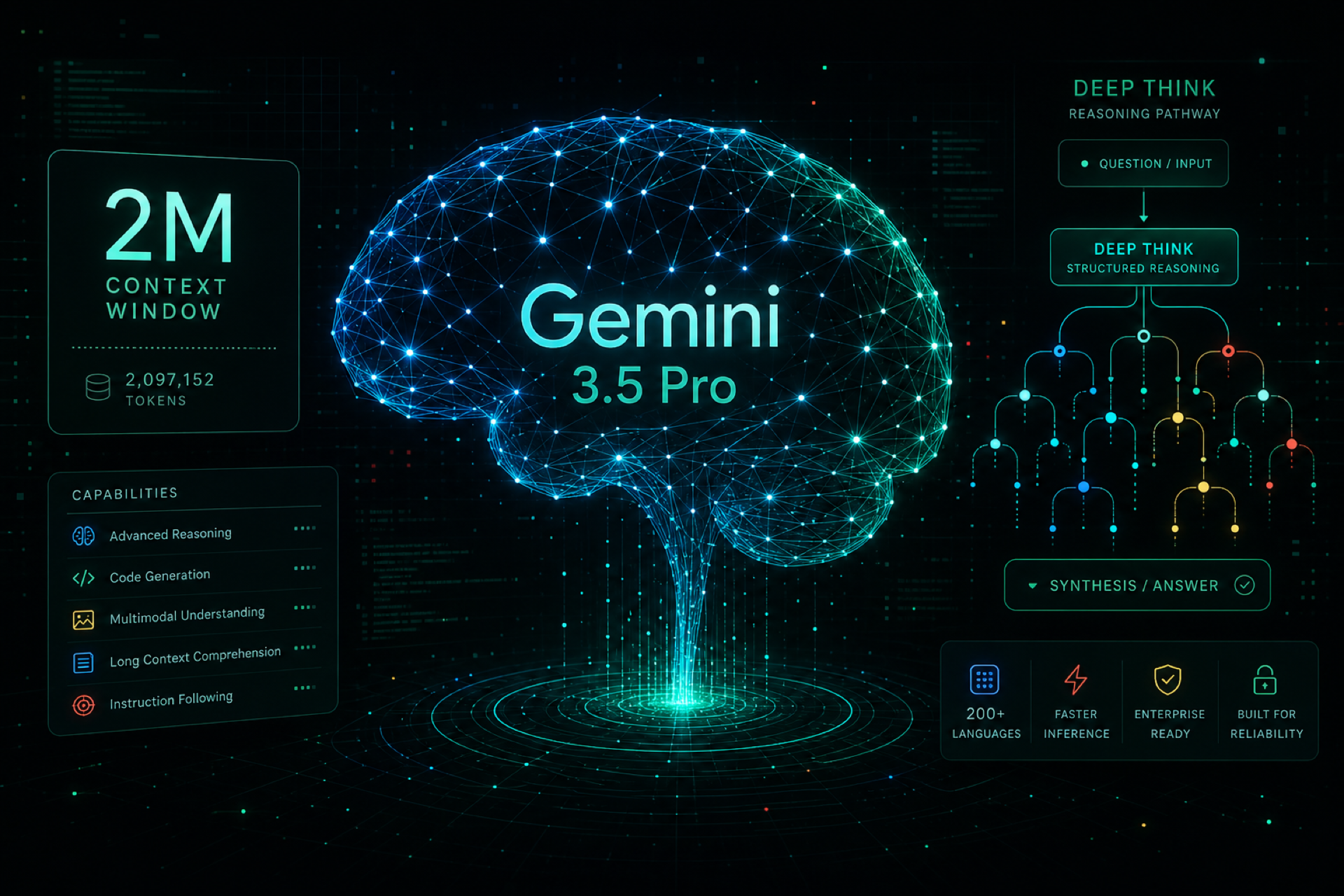
At Google I/O 2026 in May, Sundar Pichai launched Gemini 3.5 Flash (already GA) and Gemini 3.5 Pro (flagship preview) on the same stage. Pro is not a scaled-up Flash — Google chose to rebuild from scratch rather than iterate incrementally, targeting the three hardest problems for frontier models today: ultra-long context, deep reasoning, and multi-step agent orchestration. This article breaks down 10 capability upgrades from a developer’s perspective, with a side-by-side guide for choosing between Flash, Claude, and GPT.
First: where Pro sits in the Gemini 3.5 lineup
Google took a dual-track launch approach at I/O 2026:
- Gemini 3.5 Flash: GA in May, the default model for Google AI Mode — optimized for speed, cost, and ecosystem reach.
- Gemini 3.5 Pro: unveiled the same day but with a delayed broad rollout, positioned as the highest-capability model in the family for complex reasoning, whole-repo analysis, and long-running agent tasks.
Notably, multiple reports say Google started over on Pro before launch — internal test builds failed to hit the expected reasoning quality, and the team chose a rebuild over a rushed ship. That helps explain why Flash has been available for nearly two months while Pro GA keeps slipping (originally targeted for late June; as of mid-July it remains in Vertex AI enterprise preview).
For developers: Flash is today’s default. Pro is a specialist weapon when you need context and reasoning at the ceiling — not a blanket replacement.
Upgrade 1: 2M-token context window
This is Gemini 3.5 Pro’s most eye-catching number: 2 million tokens — double Flash (1M) and the largest production-grade context among mainstream frontier models today.
| Comparison | Max context | Relative to Pro |
|---|---|---|
| Gemini 3.5 Pro | 2M tokens | — |
| Gemini 3.5 Flash | 1M tokens | Half |
| GPT-5.x extended tier | ~512K tokens | ~1/4 |
| Claude Opus 4.x | 200K tokens | ~1/10 |
What can 2M tokens roughly hold?
- A mid-size TypeScript monorepo (~2,000 files at ~200 lines each)
- Three years of Slack export for a 30-person team
- Four complete SEC S-1 filings in context at once
- A full civil litigation file (complaints, depositions, evidence, trial transcripts)
Key judgment: fitting in context ≠ worth loading everything. A 2M-token prefill adds significant latency and input cost; if the answer lives in a small slice of the corpus, RAG + Flash is often cheaper. Pro’s context edge shows up when cross-file relationships must be visible at once — whole-repo security audits, multi-contract clause cross-checks, long-running agents that resist context handoffs.
Upgrade 2: Deep Think reasoning mode
Deep Think is Google’s product name for extended inference-time compute. Before emitting a final answer, the model spends more reasoning cycles on intermediate derivation and self-correction instead of fast pattern matching.
Control it via the API’s thinkingConfig parameter — four levels:
| thinkingLevel | Best for | Latency impact |
|---|---|---|
minimal | Simple queries, fast responses | Lowest |
low | Standard completions | Low |
medium | Multi-step reasoning | Moderate |
high | Math proofs, architecture decisions, multi-constraint optimization | Highest |
import { GoogleGenerativeAI } from "@google/generative-ai";

const genAI = new GoogleGenerativeAI(process.env.GEMINI_API_KEY);

const model = genAI.getGenerativeModel({
  model: "gemini-3.5-pro",
  generationConfig: {
    thinkingConfig: { thinkingLevel: "high" }
  }
});
Important cost note: reasoning tokens count toward the context budget and are billed at the output token rate. A hard problem with heavy intermediate reasoning can burn substantial tokens before the final answer appears. Deep Think is a “hard problem switch,” not the default mode.
Flash does not support Deep Think — one of Pro’s exclusive capabilities.
Upgrade 3: Multi-step agentic research loops
Compared with Gemini 3.1 Pro, the 3.5 generation makes a clear generational jump in agentic capability. Pro natively supports multi-step research loops: the model can plan its own retrieval path, traverse multiple sources, synthesize internally, then answer — rather than a single “search once, answer once” round.
Direct impact on these workflows:
- Competitive / market analysis: cross-checking multiple earnings reports, press releases, and product docs
- Technology selection research: official docs, GitHub issues, and community threads in parallel
- Compliance review: locating conflicting clauses in large policy libraries
If you already use Google AI Mode’s “Deep Research,” the Pro-powered version should handle longer, more complex research chains in theory — but real-world quality needs post-GA testing.
Upgrade 4: Autonomous workflows and tool-chain orchestration
Per I/O announcements and third-party developer reports, Gemini 3.5 Pro inherits Flash’s agentic architecture and strengthens tool-call chains: the model can string multi-step tasks like “read code → run tests → fix bug → re-run tests” into autonomous workflows instead of waiting for confirmation at every step.
Combined with the MCP tool protocol, Pro can in theory:
- Discover available tools via MCP (filesystem, GitHub, databases, etc.)
- Decide call order based on task complexity
- Keep long-running task state inside a 2M-token window
For indie developers and small teams, that means offloading more glue logic to the model while humans review final output. In production, still add permission boundaries and human checkpoints — autonomous ≠ unattended.
Upgrade 5: Google Antigravity multi-agent coordination
The Gemini 3.5 family is tightly integrated with Google’s Antigravity dev platform, launched around the same time. Antigravity lets Pro deploy parallel sub-agents: independent agents advance subtasks concurrently while a main agent coordinates and merges results.
Typical workflow:
- Sub-agent A: scan for security vulnerabilities
- Sub-agent B: check for outdated dependencies
- Sub-agent C: draft fix PRs
- Main agent: compile the report and prioritize
This maps closely to the “Orchestrator + Workers” pattern in our multi-agent architecture deep dive. Antigravity productizes the orchestration layer and lowers the bar for building your own agent framework.
If you already run OpenClaw or self-hosted agents on a cloud Mac, watch whether Antigravity opens self-hosted integration — today it remains mostly inside Google’s ecosystem.
Upgrade 6: Full-modality document-level understanding
Multimodal has always been a Gemini strength. 3.5 Pro strengthens image reasoning and document-level understanding — not just OCR text extraction, but structured semantic analysis of charts, scans, and mixed-layout PDFs.
Practical uses:
- Drop architecture or flow diagrams into context for code generation
- Analyze tables and handwritten notes in scanned contracts
- Joint reasoning over video keyframes + subtitles (exact support per official model card)
For iOS / macOS developers: put Xcode screenshots, Instruments reports, and design comps in Pro context so the model can cross-modally connect “what the UI looks like” with “what the performance data says.” Flash can do this too, but Pro’s long context makes “full design spec + all screenshots + codebase” visible at once.
Upgrade 7: Long-context retrieval accuracy
“Can hold 2M tokens” and “can still retrieve accurately after loading” are different problems. Early long-context models suffered from lost in the middle — quality collapsed when key facts sat in the middle of the window.
Google claims improved full-window retrieval accuracy on 3.5 Pro, aiming for usable recall even near 2M tokens. If true, that directly determines whether “load everything” beats chunked RAG.
Recommended approach after GA: run your own needle-in-a-haystack tests on business corpora — bury one critical fact at 500K, 1M, and 1.5M tokens and check extraction accuracy. Do not trust launch-stage numbers alone.
Upgrade 8: Frontier reasoning benchmark gains
At I/O, Google hinted 3.5 Pro would recover and exceed frontier levels on hard reasoning benchmarks like ARC-AGI-2 and Humanity’s Last Exam (HLE) — closing the gap where Flash traded abstract reasoning for speed.
As of mid-July 2026, official benchmarks are not fully published, and third parties lack fair comparisons under the same harness. So:
- Whether reasoning beats Claude Opus 4.8 / GPT-5.5 — direction only, no firm conclusion yet
- Google’s strategy looks more like leading on context length than head-on dominance on every agentic coding leaderboard against Anthropic
When choosing, ask: is your bottleneck “not reasoning deep enough” or “context does not fit”? Wait for benchmarks on the former; Pro already has clear differentiation on the latter.
Upgrade 9: Ground-up re-architecture
Easy to overlook, but important for long-term users: Gemini 3.5 Pro is not a parameter-scale bump of 3.1 Pro — it is a retrained model after internal tests missed the quality bar at Google DeepMind.
Practical impact:
- Behavior may diverge significantly from 3.1 Pro — existing prompt templates and system prompts need retuning
- Delayed GA buys a quality floor — good for production, but early integration docs and pricing stay unstable
- Shares some agentic infrastructure with Flash — migrating toolchains from Flash to Pro is relatively small
Upgrade 10: Open API and OpenAI-compatible endpoint
Pro will ship through multiple channels:
| Channel | Status (2026-07-15) | Notes |
|---|---|---|
| Vertex AI | Enterprise preview | Model ID: gemini-3.5-pro-preview-06, allowlist required |
| Google AI Studio | Opens after GA | Best for individual developer experiments |
| Gemini API (REST/SDK) | Opens after GA | Official Python / TypeScript SDKs |
| OpenAI-compatible endpoint | Supported in AI Studio today | Point existing OpenAI SDK at a new base URL |
| Gemini Advanced subscription | Expected with GA | Consumer entry point |
For long-context workloads, Context Caching is the key cost lever: cached input can run ~90% cheaper than standard input — ideal for “same large context, many follow-up questions” (whole-repo audits, multi-turn legal Q&A).
const cachedContent = await genAI.cacheContent({
  model: "gemini-3.5-pro",
  contents: [{ role: "user", parts: [{ text: largeContext }] }],
  ttl: "3600s"
});

const model = genAI.getGenerativeModelFromCachedContent(cachedContent);
const result = await model.generateContent("Based on the context above, find all SQL injection risks");
Pro vs Flash vs competitors: one table
| Dimension | Gemini 3.5 Pro | Gemini 3.5 Flash | Claude Opus 4.8 | GPT-5.5 |
|---|---|---|---|---|
| Context | 2M tokens | 1M tokens | 200K tokens | ~512K tokens |
| Deep reasoning | Deep Think | None | Extended thinking | o-series |
| Input price (est.) | $12–15 / M | $1.50 / M | ~$20 / M | ~$15 / M |
| Output price (est.) | $36–45 / M | $9 / M | ~$60 / M | ~$60 / M |
| GA status | Preview | GA | GA | GA |
| Best fit | Ultra-long context, whole-repo analysis | Daily high-throughput | Agentic coding | Structured multi-step tasks |
Pricing is preview-stage estimates — check Google’s official pricing page after GA. For broader model routing, see our OpenRouter Top 10 rankings.
How to access it: availability and timeline
As of July 15, 2026:
- Public Gemini API model lists still center on
gemini-3.5-flashandgemini-3.1-pro-preview— no broad GA listing for gemini-3.5-pro yet - Multiple reports point to around July 17 as a GA target, but Google has not published a formal model card or pricing — treat it as planning guidance, not a production dependency
- Enterprise customers can request Vertex AI preview access for
gemini-3.5-pro-preview-06
Action plan for individual developers today:
- Run business logic and toolchain integration on Flash
- Prepare Pro prompts and cost models (especially Deep Think + long context)
- After GA, A/B the same tasks on Flash vs Pro — use real token usage and output quality to set routing rules
Verdict: who should wait for Pro, who is fine with Flash today
Gemini 3.5 Pro is a specialist tool, not a universal replacement.
Teams worth waiting for / prioritizing Pro:
- Legal, finance, compliance — cross-analysis of multiple long documents
- Security audits — whole codebase visible at once
- Long-running agents — session state spanning hours without aggressive context compression
- Hard reasoning — math, architecture, multi-constraint optimization; willing to trade latency and tokens for accuracy
Teams that should stay on Flash for now:
- Day-to-day coding assistance, single-file edits
- High-throughput API pipelines (support, content generation, classification)
- Knowledge-base Q&A covered by RAG
- Latency-sensitive production paths
Of the 10 upgrades, only two truly change the game: 2M tokens and Deep Think. The rest (agentic loops, Antigravity, multimodal) are largely covered by Flash; Pro raises the ceiling. Decide whether your bottleneck is “does not fit” or “does not think deep enough” before paying for Pro.
Need a build environment online 24/7 for agents?
Dedicated cloud Mac mini M4 bare metal — built for Xcode CI, self-hosted runners, and always-on OpenClaw agents. Tokyo, Singapore, and Hong Kong nodes; pay by the day. View pricing →
Further reading
FAQ
Gemini 3.5 Pro vs Gemini 3.5 Flash — how do I choose?
Pick Flash for everyday chat, high throughput, and cost sensitivity. Pick Pro when you need the full 2M-token context, Deep Think reasoning, or complex agent research loops. Pro unit pricing runs roughly 8–10× Flash.
Can I use Gemini 3.5 Pro today?
As of mid-July 2026, Pro remains in Vertex AI enterprise preview. The public Gemini API still lists gemini-3.5-flash and gemini-3.1-pro as the main options. Broad GA is expected in the second half of July — follow Google’s official docs for the latest.
How much does Deep Think add to cost?
Reasoning tokens count toward the context budget and bill at output token rates. Hard problems can consume large token volumes before the final answer. Enable Deep Think only for high-stakes tasks like math proofs and architecture decisions.
What is 2M-token context best for?
Whole-repo code audits, cross-checking multiple legal or policy documents, and long-running agent session state. For single-file edits or RAG-friendly knowledge bases, Flash plus chunked retrieval is usually cheaper and faster.
Can I call Gemini 3.5 Pro with my existing OpenAI SDK?
Yes. Google AI Studio exposes an OpenAI-compatible endpoint — most existing OpenAI SDK code only needs a new base URL and model name.