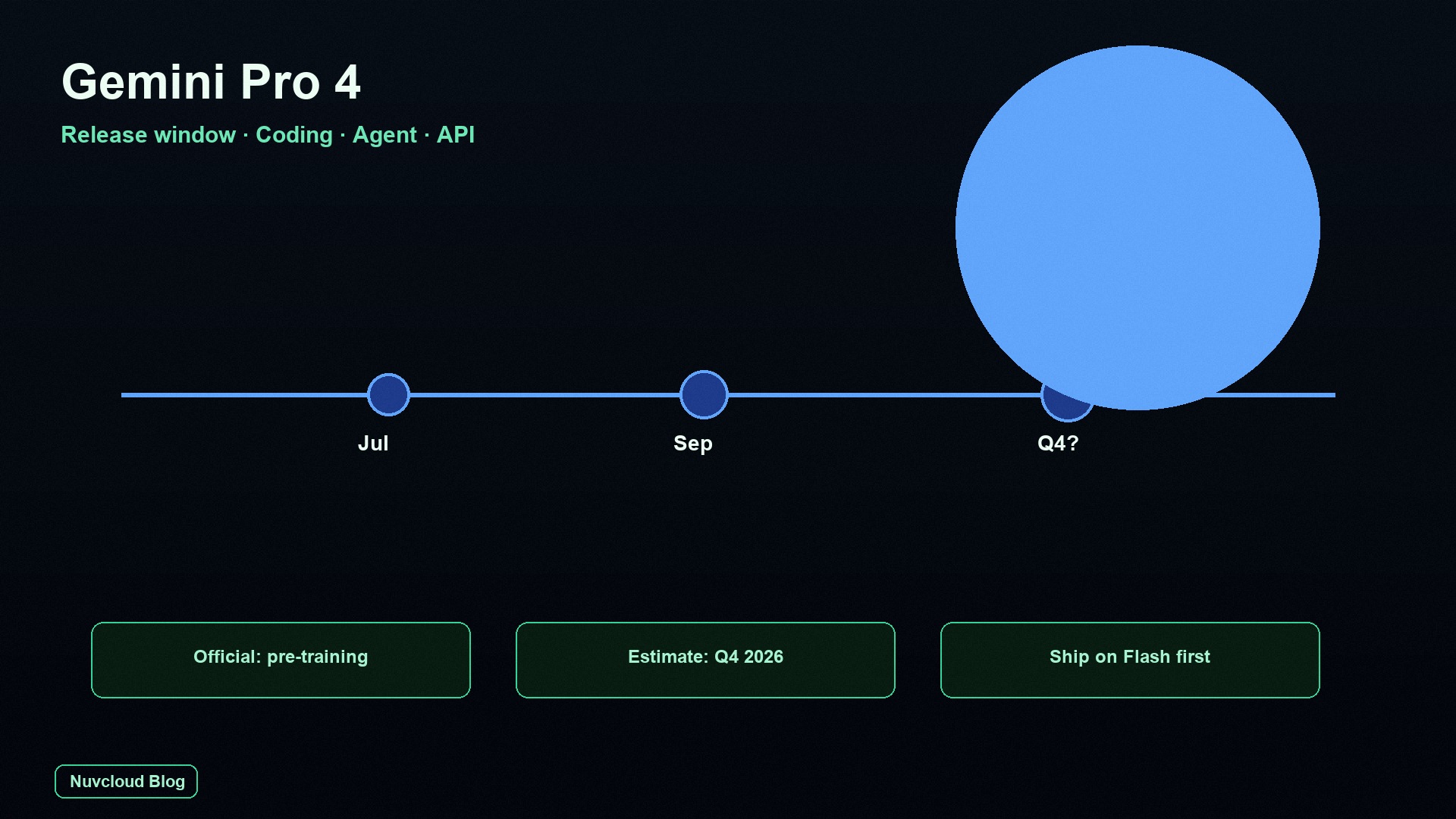
As of September 11, 2026, Google has not announced a formal release date, API model ID, or pricing for “Gemini Pro 4 / Gemini 4 Pro.” What is official: in July Google started its “most ambitious” Gemini 4 pre-training run to date, while Gemini 3.5 Pro remains in partner testing and is not broadly available. Community chatter about “Gemini Pro 4” maps more cleanly onto the official story of a Gemini 4 flagship (often assumed to ship as Gemini 4 Pro). This piece separates confirmed facts, unofficial timing windows, and AI Coding / Agent / API capability forecasts so you can make build decisions—not chase rumors.
Naming first: Gemini Pro 4 ≠ an official SKU?
Search traffic for “Gemini Pro 4” is high, but Google DeepMind / Gemini API docs follow a “major version + tier” pattern: Gemini 3.1 Pro, Gemini 3.5 Flash, Gemini 3.8 Flash. Historically there is almost never an official SKU that puts the tier first and the version second the way “Gemini Pro 3” would.
A safer reading is:
- User slang: Gemini Pro 4 ≈ “next-gen flagship Pro”
- Official narrative: Gemini 4 (in pre-training) → later likely split into Flash / Pro / Lite tiers
- Current flagship gap: the 3.x line is iterating mainly on Flash; 3.5 Pro is still marked coming soon
What Google has said: timeline and status
Here is what you can put in a decision memo, ordered by date (public reporting and official blogs only):
| Date | Event | What it means for a release day |
|---|---|---|
| 2026-05 | Google I/O: Gemini 3.5 Flash GA; Managed Agents / Antigravity 2.0 introduced | Agent stack landed ahead of the next flagship |
| 2026-07-21 | DeepMind blog: ships 3.6 Flash and more; states Gemini 4 is the “most ambitious pre-training run yet” | Training confirmed underway; no GA date |
| 2026-07-22 | Alphabet earnings commentary reiterates Gemini 4 pre-training progress | Aligned with the blog language |
| 2026-08–09 | Flash line keeps minor advances (e.g. 3.7 / 3.8 Flash) | Public capability focus remains high-throughput Flash |
| As of 2026-09-11 | Models page still shows 3.5 Pro “coming soon”; no Gemini 4 product page / API ID | Flagship not ready—you cannot schedule “swap the model name next week” |
Bottom line: Gemini 4 is training, but it has not “shipped.” What you can call reliably today is still the 3.x Flash family and existing Pro tiers (e.g. 3.1 Pro), plus the Agent APIs that landed after I/O. For 3.5 Pro capability detail, see our breakdown of ten Gemini 3.5 Pro upgrades; for spend, see Gemini API cost estimates.
Release window: official silence vs market guesses
Official silence is not the same as “nobody is guessing.” Label confidence so media extrapolation is never treated as a Google commitment:
| Source type | Common claim | Confidence | How to use it |
|---|---|---|---|
| Official | Pre-training in progress; 3.5 Pro coming as soon as practical | High | Roadmap dependency: “unconfirmed” |
| Media extrapolation (cadence) | ~Nov–Dec 2026 | Medium | Budget and eval window only—not an SLA |
| Unverified leaks | Pro public in October; lighter tiers in September | Low | Sentiment tracking only; do not change production models |
| Historical pattern | Major versions often ship Flash / preview first, then Pro GA | Medium | Expect staged rollout, not a single big-bang day |
For engineering teams, the useful judgment is not “which month to bet on,” but:
- Until a model ID appears, do not treat keynote screenshots as an API contract.
- Flash first, Pro later remains the higher-probability path—flagships are usually costlier, slower, and tighter on quota.
- If 3.5 Pro GA precedes Gemini 4, near-term “need deep reasoning” demand may land on 3.5 Pro first—not a direct jump to 4.
Forecast 1: How AI Coding may change
This is a forecast, not a roadmap. The basis: Flash has already pushed coding / reasoning close to—and sometimes past—older Pro; Antigravity’s default backbone is high-throughput Flash; competitors (Claude / GPT) keep raising the bar on repo-scale edits and tool loops.
If Gemini 4’s flagship lands as advertised—“most ambitious pre-training yet”—AI Coding is more likely to strengthen these directions:
- Longer, more stable multi-file edits: fewer “fix A, break B” and fake green builds.
- Deeper test-driven loops: run tests → read failures → patch again, instead of one-shot megapatches.
- Tighter coupling to sandbox toolchains: code execution, filesystem, and search retrievers as first-class citizens—not bolted on afterward.
- Lower cost of repo-scale understanding: either more usable context, or sharper retrieval + compression (your bill cares either way).
For indie developers and small teams, the real gap is often not “#1 on a flagship leaderboard,” but a local or remote Mac environment that can run Agents reliably—Xcode, Docker, Node, secrets, and 24/7 SSH. For desktop-assistant comparisons, see Siri AI vs ChatGPT vs Gemini on Mac.
# Pseudocode: make the model a config, not a hardcoded business constant
MODEL_CODING = os.getenv("GEMINI_CODING_MODEL", "gemini-3.8-flash")
MODEL_HEAVY  = os.getenv("GEMINI_HEAVY_MODEL", "gemini-3.1-pro")  # or future 3.5/4 Pro

client = genai.Client(api_key=os.environ["GEMINI_API_KEY"])
resp = client.models.generate_content(
    model=MODEL_CODING,
    contents="Review this diff for security regressions:
" + diff_text,
)
Practically: freeze a small golden set of coding tasks now—auth refactors, flaky-test fixes, dependency bumps—and score every new model ID against that set. When Gemini 4 (or 3.5 Pro GA) appears, you want a one-line env change plus a regression run, not a week of rediscovering which prompts “felt better.” Keep latency and dollar-per-session dashboards beside accuracy; a smarter model that burns 8× tokens can still lose the product case.
Forecast 2: Agents and the Antigravity path
Google has already productized “managed agents”: via the Antigravity agent and Interactions API, a single call can reason, run code, manage files, and search the web inside a Google-hosted Linux sandbox. The default backbone today points at Flash (docs often show gemini-3.8-flash), not an unreleased Gemini 4.
So the more grounded Agent forecast for Gemini 4 is not “Agents get invented overnight,” but:
- Same harness, stronger brain: once
agent_config.modeloffers a flagship option, long-task success rates rise. - Longer sessions, fewer human interrupts: better context compression and tool-error recovery.
- Custom agents / MCP stay table stakes: hang internal APIs, tickets, and CI inside the sandbox.
- Cost layering: day-to-day orchestration stays on Flash; escalate critical decision steps to Pro/4.
If you are waiting for a “stronger computer-use Agent” (including OpenAI’s desktop-agent narrative), hardware and always-on sessions often become the bottleneck before the model name does—see the environment checklist framing in OpenAI Astra and Mac AI Agent prep.
Forecast 3: API surface and integration shape
Combining directions announced at I/O 2026 (see I/O developer highlights) with current docs, the Gemini 4 generation is more likely to extend these shapes than reinvent them:
| Capability | Status (summer–fall 2026) | What a flagship generation is more likely to strengthen |
|---|---|---|
| Generative calls | Flash iterates frequently; OpenAI-compatible endpoints available | New model IDs, higher reasoning tiers, quota tiers |
| Interactions / Managed Agents | Antigravity preview available | Optional flagship models; richer environment and skill templates |
| Tools & MCP | Code exec, search, URL, custom functions, remote MCP | More reliable multi-step tool planning and failure retries |
| Multimodal | Image / audio / video paths already in motion | More reliable long video and complex UI screenshot understanding |
| Billing | Flash price war intense; Pro markedly more expensive | High odds flagship prices “deep reasoning tokens” separately |
Engineering advice for right now: finish three things—configurable model names, a frozen eval set, and cost alerts. When the flagship ships, you want “flip an env var + run regressions,” not a half-repo refactor.
What to do now: decision table and checklist
| Your goal | Do now | Wait for Gemini 4 / 4 Pro |
|---|---|---|
| Daily coding assist, high throughput | Ship latest stable Flash + tool loops | No need to wait |
| Long-doc / deep-reasoning pilots | Track 3.5 Pro availability; use existing Pro meanwhile | Blind A/B 3.5 Pro vs 4 Pro |
| Production Agents | Get Antigravity / your own harness working first | Only A/B a model tier bump |
| Procurement & budget | Model costs on Flash unit price; leave 5–10× headroom for Pro | Lock annual commits only after official price cards |
| Marketing copy “we already support Gemini Pro 4” | Forbidden | Only after a public model ID and SLA |
Pre-launch self-check (paste straight into the sprint board):
- Can business code switch
GEMINI_*_MODELvia config? - Do you have 20–50 fixed regression prompts (coding, tool use, long-form summary)?
- Do you monitor tokens / USD per session with a kill switch?
- Do Agents run in isolation (sandbox or dedicated cloud Mac), not a developer laptop?
- Does external comms strictly separate “officially shipped” from “media speculation”?
Put AI Coding Agents on a cloud Mac for stability
A stronger flagship model does not fix sleeping laptops, flaky corporate VPN, or Xcode / Docker fighting for RAM. Nuvcloud cloud Mac mini (dedicated Apple Silicon bare metal) is built to keep Gemini / Claude / Codex-class Agents, CI, and MCP gateways online 24/7: enough unified memory bandwidth, always-on SSH, and day-flexible capacity.
If you are preparing an environment where “the model upgrades and we re-run evals immediately,” review Nuvcloud plans and nodes and pull unreliable personal machines off the critical path.
Further reading
FAQ
When exactly does Gemini Pro 4 ship?
There is no official date. As of September 11, 2026, Google has only confirmed that Gemini 4 pre-training is underway. Media guesses often land on Nov–Dec 2026, with lower-confidence October chatter—none of that is an SLA.
Are Gemini Pro 4 and Gemini 4 Pro the same thing?
They most likely point at the same expected flagship generation. Official naming habits look like “Gemini 4 Pro”; “Gemini Pro 4” is mostly search slang. Final word belongs to Google’s launch page and API model IDs.
Should we wait for Gemini 4 before integrating?
No. Ship stable Flash plus existing Pro if you need it, and keep model names configurable. When the flagship lands, run regressions—don’t stall the business for an empty window.
Could Gemini 3.5 Pro be available before Gemini 4?
Yes. Google has repeatedly said 3.5 Pro is in partner testing and will broaden access soon, while Gemini 4 is still in pre-training. Near-to-mid-term “need Pro capability” should track both tracks.
Will Gemini 4 meaningfully improve AI Coding?
That is the expectation—especially multi-file edits, test loops, and tool coordination—but magnitude should be judged on public benchmarks and your own repo evals. Do not trust keynote demos alone.
Do Agents require waiting for Gemini 4?
No. Antigravity / Managed Agents already run on Flash. Gemini 4 is more likely “same harness, stronger model” than inventing an Agent API from scratch.
How much more expensive will the API be?
Not announced. History says flagship Pro is markedly pricier than Flash, and deep reasoning burns more tokens. Budget from a Flash baseline with multi-fold headroom; lock numbers only after the price card.
How do we verify third-party “we support Gemini 4” claims?
Ask for a callable official model ID, docs link, and billing line item. Blog titles or screenshots without an API contract are marketing warm-up—not support.