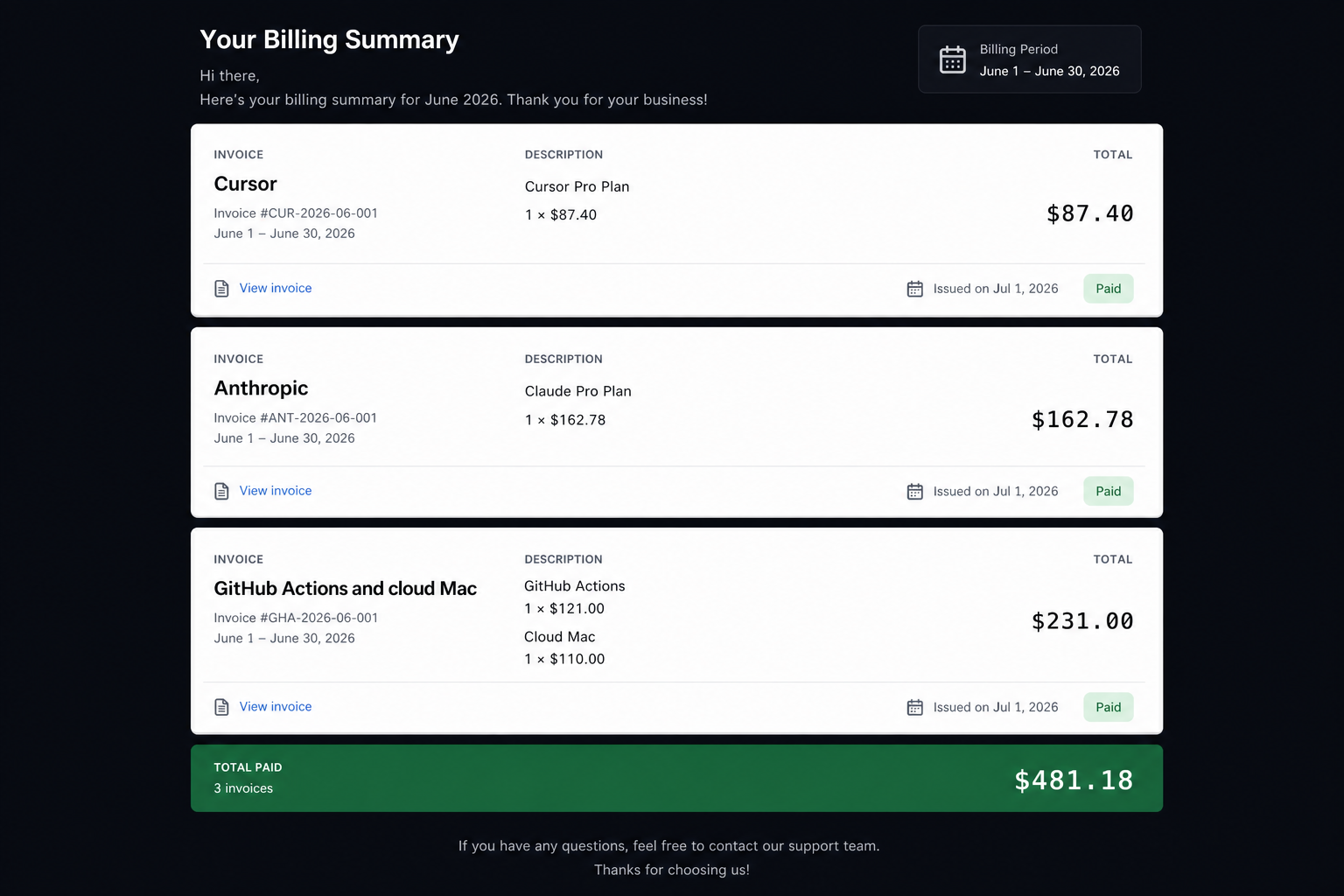
In the first half of 2026, if you ask a developer whether Agents changed their work, the answer is usually vague: “Yeah, kind of.” Ask whether the bill changed, and the answer gets specific fast: Cursor usage alerts, Claude Code overages, GitHub Actions macOS minutes, a cloud Mac that never sleeps — each line item lives in a different dashboard, but they all hit the same corporate card.
That is the tension this article is about: the Agent era is still being narrated as “just getting started,” but the cost structure is already billing like always-on infrastructure. We have written about τ and the Agent compute curve and about the AI compute infrastructure war; those are supply-side stories. Here we stand on the developer and finance side: why the invoice arrives before the roadmap, what it actually looks like, and how to get the math right before Agents spread through the org.
1. Why the bill arrives before the capability story
During the Copilot era, the mental model was simple: $10–$20 per person per month, one more IDE plugin on the card. From late 2025 onward, Claude Code, Cursor Agent, OpenClaw-style gateways, and similar tools changed the interaction shape to long task loops: read the repo → run a command → inspect output → replan. Every loop burns tokens; every tool call may trigger a Runner, CI job, or shell on a remote Mac.
Marketing talks about “ship a feature while you sleep.” Billing systems count input tokens + output tokens + cache read/write + third-party API pools. According to Cursor’s official pricing docs, Pro includes roughly $20/month of API credit, but a “typical daily Agent user” often lands at $60–$100/month total; heavy automation can exceed $200. Claude Code’s enterprise guidance cites roughly $13 per active day, or $150–$250 per person per month depending on model choice and repo size — with wide variance.
In other words: product maturity still feels Beta, but billing maturity already runs on cloud-native usage meters. If your team still budgets Agents like “one Copilot seat per engineer,” month one will not reconcile.
US teams feel this acutely because procurement still thinks in SaaS seats while engineering adopted usage-priced shells first. A staff engineer running Opus on a monorepo can burn through a “team tools” line item in a week without anyone in finance noticing until the card statement closes. The gap is not ignorance — it is latency between adoption and visibility.
2. Agent spend is not one invoice: the five-bucket model
Split AI-related spend in a typical 2026 dev stack and you get at least five buckets. They are purchased separately, alert separately, and still chain together in one engineer’s workflow.
| Bucket | Typical products | Billing shape | What changed in the Agent era |
|---|---|---|---|
| L1 Models & IDE | Cursor, Claude Max, Copilot | Monthly fee + usage pool / tokens | From autocomplete to Agent orchestration; Max Mode and long context drain pools faster |
| L2 Direct API | Anthropic / OpenAI Console, Agent SDK | Raw tokens + tool calls | Automation scripts and parallel Agents bypass IDE caps |
| L3 Execution environment | Local Mac, cloud Mac, Dev Container | Hardware depreciation or monthly rent | Long tasks need always-on hosts; laptop sleep = interrupted job = rerun = more tokens |
| L4 CI / Runner | GitHub Actions macOS, self-hosted Runner | Minutes or fixed machine slot | Agents trigger webhooks and test matrices — tied to Runner TCO |
| L5 Data & integration | Vector DB, Notion/GitHub Apps, monitoring | Seats + storage + requests | RAG, Memory, ECC-style harnesses lengthen the context chain |
When any one bucket runs hot, the symptom is “Agents are expensive.” More often, each bucket looks reasonable alone and the sum surprises you — finance sees six invoices while engineering thought you “only added Cursor.”
3. From Chat to Agent: why the usage curve steepens
Classic Chat cost is roughly linear: you ask, the model answers. Agent cost looks more like steps × context volume × model unit price:
- Steps: “Fix this bug” may be 20–80 inference and tool-call rounds under the hood;
- Context: repo search, terminal logs, and chat history fill the window — input tokens accumulate per turn;
- Failed retries: when tests fail, the Agent reruns the whole chain, not one sentence;
- Parallelism: Claude Code’s multi-agent patterns can multiply token burn versus a single session.
That aligns with the Jevons effect under τ: as unit compute gets cheaper, teams assign bigger tasks to Agents, and total spend rises. The Agent era is not “cheaper AI” — it is AI you dare to use harder. The bill arrives first because “daring to use” outruns process maturity.
| Scenario | Single Chat (approx.) | Long Agent task (approx.) | Bill sensitivity |
|---|---|---|---|
| Explain a function | 1 turn, a few thousand input tokens | Often still 1 turn | Low |
| Cross-file refactor | Human pastes many rounds | 10–40 turns + disk reads | High |
| “Make CI green” | Hard to finish in Chat | Run tests + edit YAML + rerun | Very high (plus L4 Runner) |
| 24/7 monitoring Agent | Not applicable | Always on + scheduled triggers | Continuous burn |
A practical US example: a Series A mobile team pointed an Agent at “fix flaky UI tests.” The model burned tokens on three YAML iterations, then triggered four macOS workflow runs at peak queue pricing. L1 looked like $12; L4 added $40; L3 reruns on a sleeping MacBook added another invisible $8 in duplicate L2 calls. Nobody planned for a $60 Tuesday.
4. Three real bill profiles: solo, small team, enterprise pilot
Figures below are typical mid-2026 ranges for US-based teams — use your own consoles as source of truth.
4.1 Solo developer (Agent-first workflow)
Cursor Pro ($20) + API overage ($30–$80) + Claude Max or direct API ($20–$100) + an always-on Mac or cloud Mac for long jobs ($3–$15/day amortized). $80–$200/month is common — more than many engineers remember spending on “tools,” but still below a few hours of contract dev time if the Agent actually ships.
4.2 Small team (under 10 people)
Seat fees (Cursor Teams / Copilot Business) × headcount, plus overage pools for two or three power users. If iOS pipelines use hosted macOS Runners, GitHub Actions billing becomes its own line. Classic trap: IDE seats were approved; Runner minutes and cloud Mac slots were not.
4.3 Enterprise pilot cohort
Procurement cares about compliance and audit trails; engineering cares about speed. Claude Code docs cite enterprise averages around $150–$250 per active developer per month, with ~90% of users under $30/day — but pilot groups often are the top 10% of heavy users. Without showback, a successful pilot becomes a finance shock at rollout.
5. Three root causes finance and engineering misread the same spend
Cause one: chart-of-accounts fragmentation. IDE goes to software subscriptions, API to cloud vendor contracts, Runners to DevOps, Mac rent to infrastructure — no unified “Agent COGS” line.
Cause two: usage is invisible to the person who signs. Engineers feel time saved; finance sees token curves. Cursor Dashboard, Claude /usage, and Console usage pages do not share one owner view.
Cause three: hidden multipliers. Agents trigger more CI minutes, larger log uploads, longer remote sessions — none of that appears on the model invoice, but it shows up on OpenClaw + remote Mac and Actions bills. See Opus vs IDE layering: stronger models demand stable execution environments, and environment cost is a multiplier.
6. Cost control in practice: a 30-day Agent bill audit
Before rolling Agents org-wide, run a 30-day “bill physical.” Commands and habits below cross Claude Code cost docs with Cursor’s published guidance.
# Inside a Claude Code session
/usage          # token stats for this session (local estimate)
/usage-credits  # set monthly credit cap on Pro/Max plans
/clear          # end long context so history does not roll into the next task
Audit checklist (printable):
- Export last 30 days: Cursor Usage, Claude Console, OpenAI (if used), GitHub Actions macOS minutes.
- Mark Top 5 heavy users and Top 3 expensive task types (refactors / CI fixes / doc generation).
- Measure “long session” share: how many tasks exceeded 20 tool-call rounds.
- Reconcile Runners: did Agent-triggered workflows exceed 2× pre-Agent volume?
- Reconcile environment: any jobs failed and reran because a laptop slept?
- Set next-month rules: model routing (Auto / light models daily, Opus only for hard tasks),
.cursorignore/.claudeignore, CI cache policy.
7. Infrastructure layer: where Runners and cloud Macs land in total cost
Many teams optimize L1/L2 (swap models, enable Auto) and ignore L3/L4. For iOS, macOS, and Flutter shops, an Agent that must run xcodebuild, signing, and simulators needs a macOS seat. Rough options:
- Local MacBook: zero rent, but sleep, thermals, and lid-close interrupt long jobs — fine for short tasks.
- GitHub hosted macOS Runner: zero ops, high per-minute price, ephemeral cache — fine for low-frequency PRs.
- Dedicated cloud Mac mini: fixed monthly fee, DerivedData can persist, suited to 24/7 Agents and self-hosted Runners — same TCO frame as buy vs rent cloud Mac.
Ask one extra question when sizing infrastructure: “Is this machine online for humans eight hours, or for Agents twenty-four?” The second profile favors low-power, always-plugged, SSH-auditable Mac minis — under your desk or in a datacenter row.
8. FAQ
Q1: Agent bill spiked — cut models or cut seats first?
Cut wasted rounds first, then model tier. Check whether Top tasks use Opus for lint-level work, whether Auto/Composer pools cover daily work, and whether long sessions were cleared. Cutting seats pushes people to personal API keys and bypasses governance.
Q2: Why is Cursor Pro’s $20 pool never enough?
Agents default to API-priced models; long context and Max Mode drain faster. Official docs put typical Agent totals well above $20. Route daily work through Auto/Composer pools, budget heavy tasks separately, and use team Premium seats where needed.
Q3: Are Claude Code and Cursor duplicate spend?
Overlap exists, but buckets differ. Many US teams use Cursor for visual review and Claude Code for terminal automation — two max tiers means double L1. Pick one primary Agent shell; downgrade or project-scope the other.
Q4: How do I explain “much pricier than Copilot” to leadership?
Compare output, not sticker price: same bug, four human hours vs $8 tokens plus one review hour. Pair with the 30-day audit and caps to show control. Treat Agent spend as COGS, not office supplies.
Q5: Is OpenClaw / self-hosted Agent cheaper?
Not automatically. Self-hosting avoids some IDE markup but adds Runner, remote Mac, monitoring, and on-call labor. Compare all five buckets, not API list price alone.
Q6: Will bills drop in H2 2026?
Unit prices may keep falling (Composer 2.5, more Auto routing), but adoption curves rise. Drops require mature governance — harness, routing, stable environments, finance showback — not waiting for vendor sales.
9. Verdict: learn to read the bill before the Agent strategy deck
“The Agent era just started, but the bill already arrived” is not pessimism — it is timing. Cost structure is a lap ahead of org maturity. Five buckets, steps × context × price, and the hidden multipliers on Runners and always-on Macs decide scalability sooner than “which model wins.”
For individuals: run the 30-day audit, set credit caps, put long jobs on an always-on host. For teams: unify the chart line, split IDE vs API roles, treat harness work as cost engineering. For finance: accept variable COGS, model pilots with real data, and retire Copilot-era fixed-seat thinking.
Capability will keep moving; invoices will not wait for your OKRs. Get the math right first — then Agent spend stops looking like an expensive experiment.
The hidden line item on long Agent jobs: environment stability
Model tokens are only part of the invoice. When a task dies halfway because a laptop slept, CI queued, or cache vanished — and the Agent reruns the whole chain — you burn L1 and L4 together. Nuvcloud dedicated M4 Mac minis offer always-on macOS, SSH/VNC, persistent DerivedData, and multi-region nodes so Agent compute goes toward progress, not fighting hardware state. Low-power, fanless design also suits 24/7 ECC or OpenClaw-style always-on workflows.
Start with a daily rental, run one real Agent pipeline, and compare token bills before/after fewer reruns — see pricing and fold the infrastructure layer into Agent TCO instead of discovering a Mac line item at month end.